Makonde Decorative Ebony Sculpture
Description
Ebony. Height: 90 cm · Maximum diameter: 40 cm · Minimum diameter: 20 cm · Weight: 14 kg.
The piece
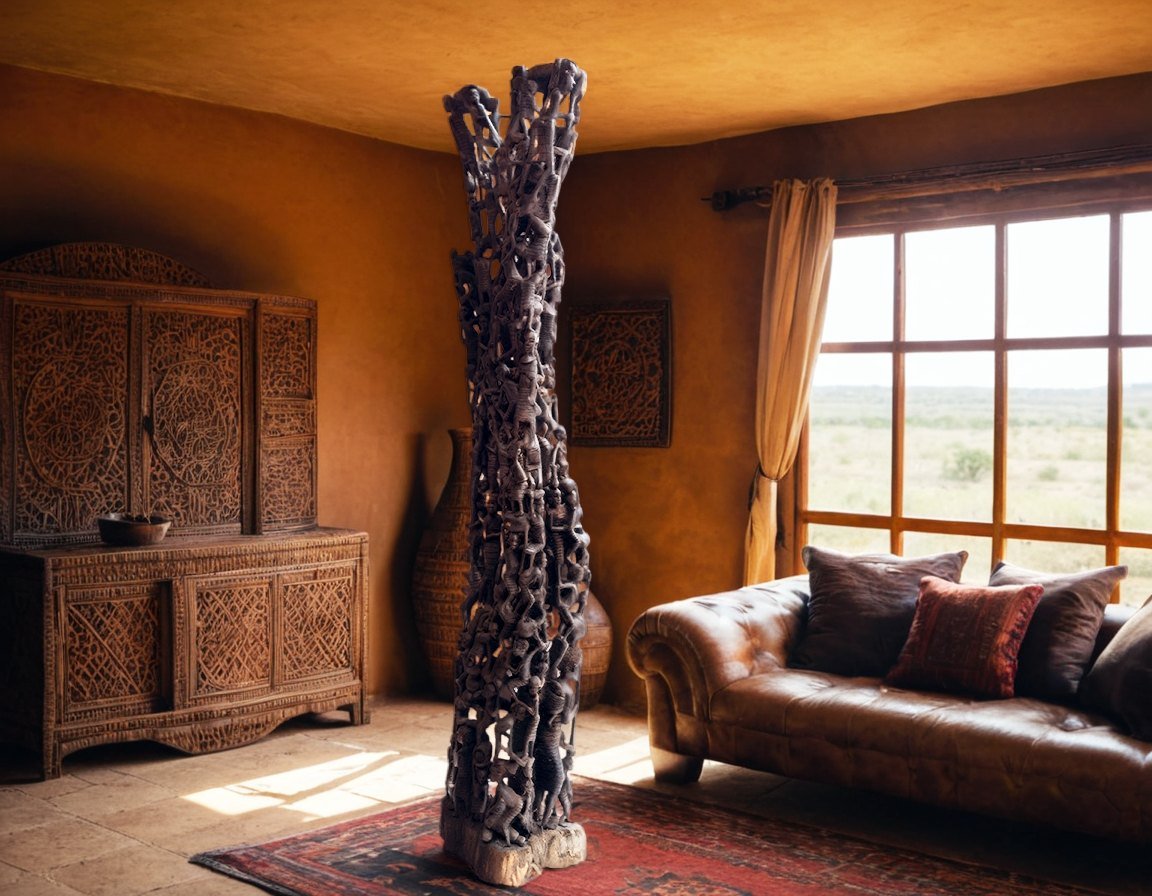
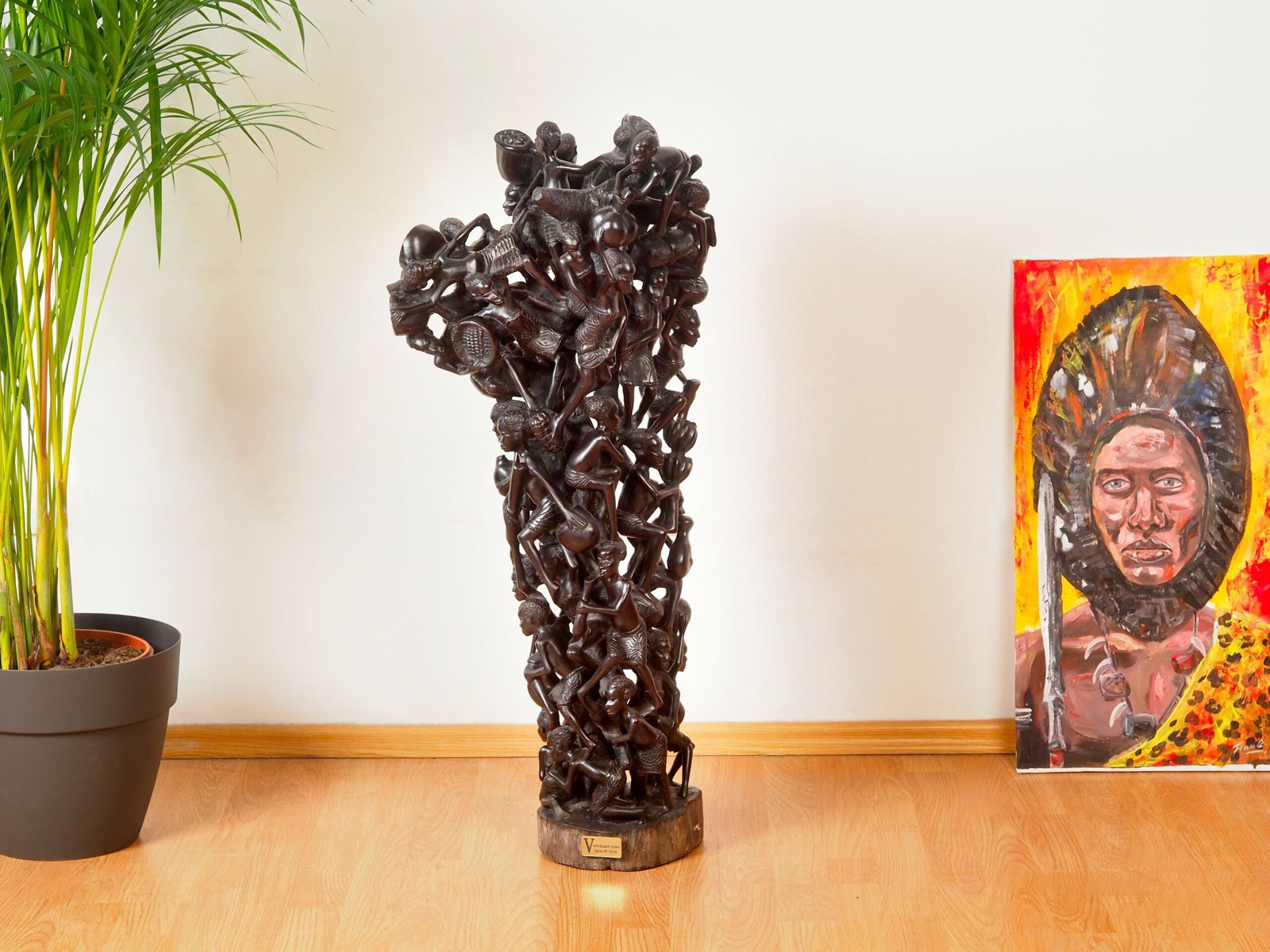
The piece narrows at the foot and opens wide at the crown, where the figures spread outward instead of climbing. The silhouette is closer to a horn or a flame than to the usual straight column, which is a decision taken at the first cut and never reversible.
How it was made
The flare costs wood: the carver must begin with a trunk far wider than the finished piece and remove most of it. Mounted on a dark turned base, the only part not from the original block.
Provenance
Carved at Mwenge, Dar es Salaam, Tanzania, by the carvers Museum Private has worked with for more than ten years. Acquired directly from the workshop; no intermediate owner. Sold by Museum Private.
The wood
The material itself is the value. Ebony and mongongo of this size are no longer a commodity; they are a find.
Why the wood is what it is: the climate. Long dry seasons stop the tree's growth and the rains start it again, year after year, so the rings close up tight instead of running loose and wide. That is what density means, and density is what makes the difference between wood that holds a cut and wood that crumbles at the edge of one. A dense trunk takes the fine detail, takes the polish, and moves less in the years afterwards.
Ebony is the extreme of it. It is so dense that it does not float, and it is among the most expensive timbers in the world — elsewhere it is sold by the kilogram, in offcuts, for instrument parts and inlay. A piece of this size in solid ebony is a quantity of the wood that is rarely seen in one object at all, let alone carved through.
A piece like this needs one trunk, of one diameter, sound all the way through. Trees of that size are no longer standing where the workshop can reach them. Finding a single usable trunk now means going hundreds of kilometres for it, looking at many and buying one, and carrying it back whole. Every piece in this collection began with that journey, before a chisel was lifted.
This is why the dimensions cannot be matched to order. The widest drum, the tallest column, the longest panel: each is as large as the tree allowed and no larger. Ask for the same piece ten centimetres wider and the answer is not a price; it is that the tree does not exist.
The tradition
Carving is not a general skill in Tanzania. Most peoples do not carve at all; only a few hold it as an inheritance, and each of those has a hand of its own, recognisable at a distance. This piece belongs to the Makonde, who carry one of the oldest of them.
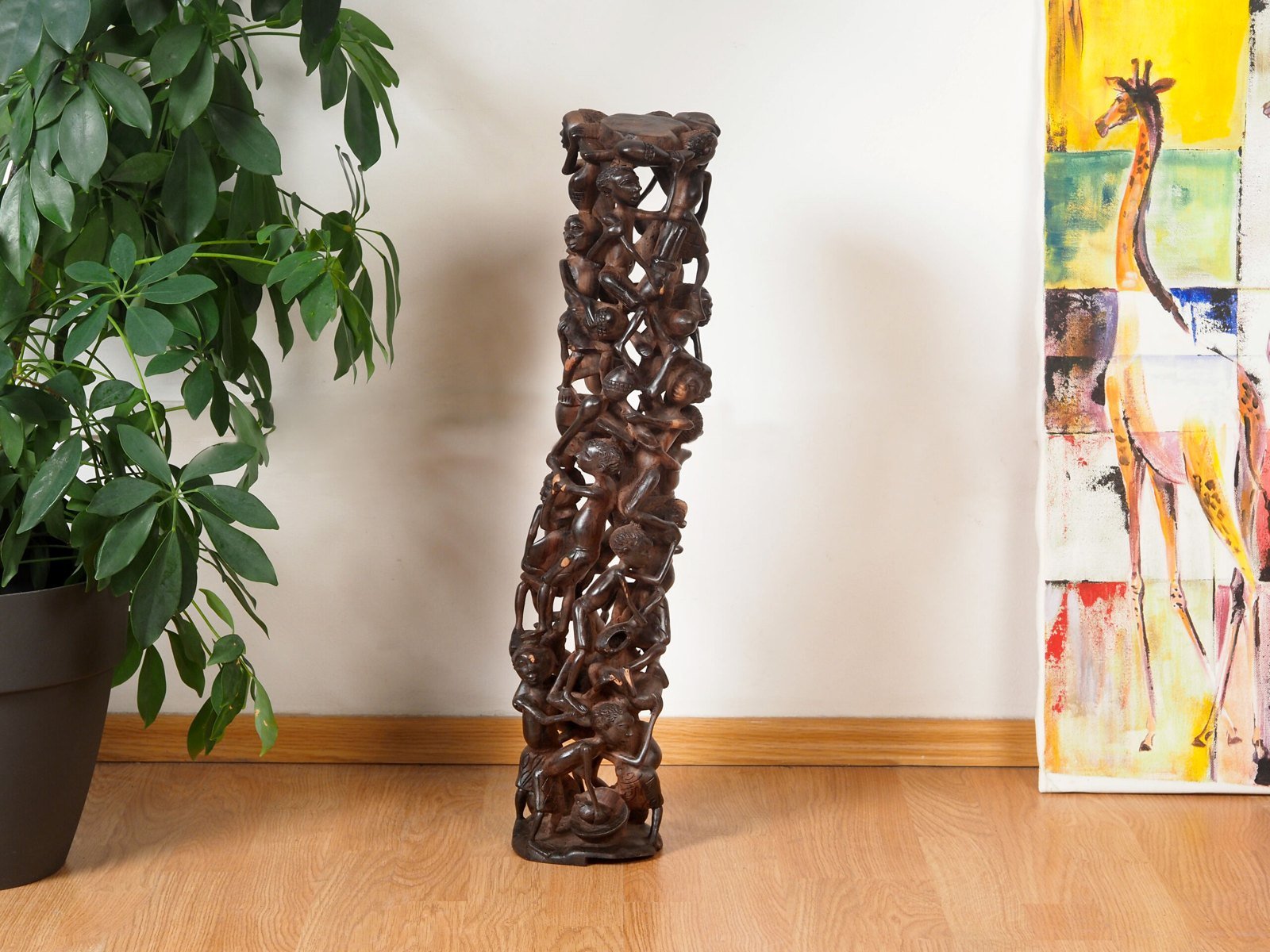
The craft is inherited, not taught in a school. It passes from master to apprentice inside the workshop, by the hand and by the eye, as it has passed down through generations for centuries. A carver spends years on small work before he is allowed near a trunk of this size, and the men who cut these pieces learned from men who learned the same way. Within the Makonde hand there are two idioms: ujamaa, the crowded column of interlocked figures cut from one trunk, and shetani, the single elongated form. Few carvers work both well.
What is ending is the generation. The men who cut these pieces are the last at Mwenge working at this level, and almost no one is coming up behind them. Museum Private has worked with this workshop for more than ten years and has watched the apprentices stop arriving: the years of unpaid small work before a carver is trusted with a trunk are years the young will not now give. When these hands stop, the work stops with them. These thirty-five are not a collection assembled to be sold; they are what that generation left.
Condition and care
Dust with a dry soft brush, working outward along the figures. Keep away from direct sun. Supplied with a certificate of origin.
Delivery
We deliver across the GCC. The arrangements are confirmed in writing with each sale. Scaled for a majlis or a reception room rather than a corridor.
A note on climate: solid hardwood in a room held at 20°C by air conditioning will lose moisture faster than it did in Dar es Salaam. Keep the piece out of the direct path of a vent and away from a window in full sun. Hairline movement along the grain in the first year is the wood settling to the room, not a fault.
Terms
One of one. Numbered and recorded in the Museum Private register, and supplied with a certificate of origin naming the wood, the workshop and the carvers. Solid hardwood throughout, no veneer and no composite. Delivered across the GCC.
Price ex workshop. Anything payable at the destination is confirmed in writing with the quotation.
Request this piece